The invisible 92 per cent
- Ian Makgill
- Insights , Technology
- 17 Jul, 2026
- 03 Mins read
Of all the consulting tenders open around the world right now, 92 per cent carry no classification code for consulting from their publisher. That means that if you rely on the publishers to furnish their notices with the correct CPV, NAICS or UNSPSC codes, you are going to be searching just 8 per cent of the market.
Here is what that looks like on a single record.
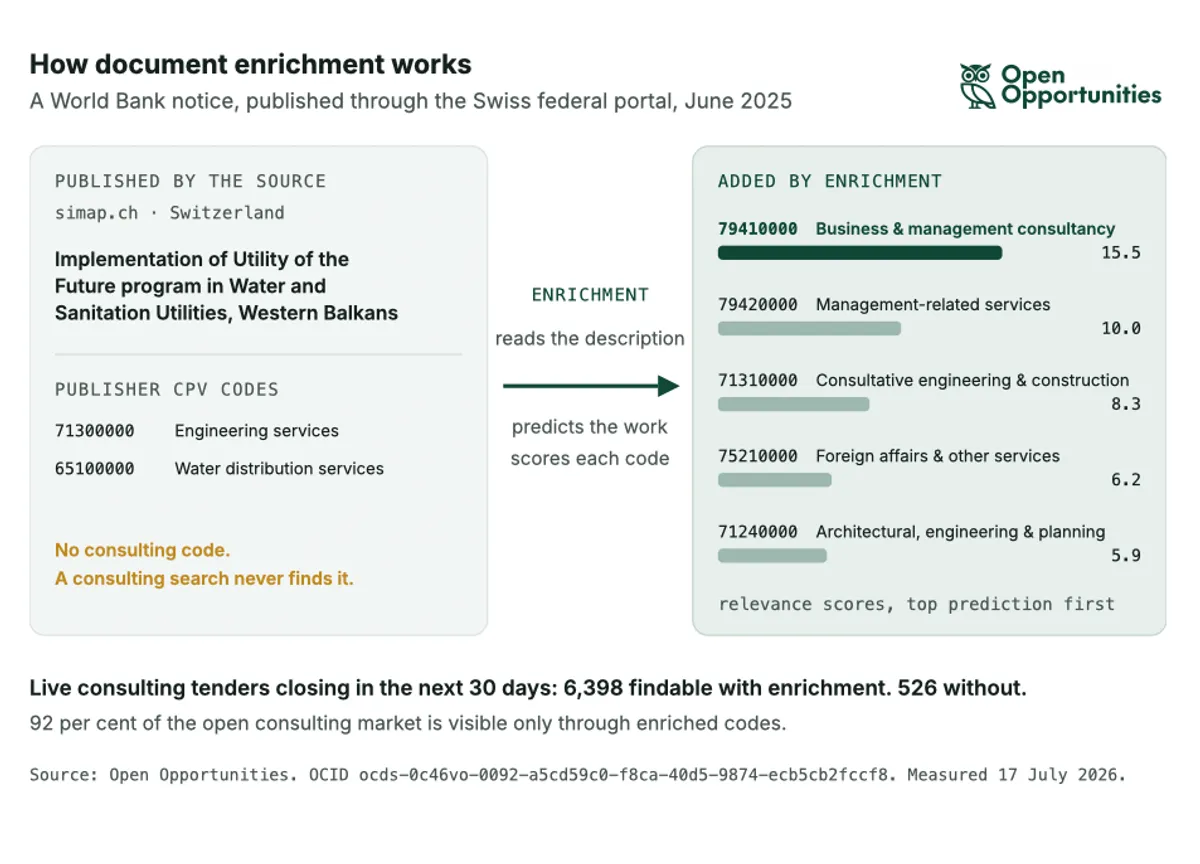
In June 2025 the World Bank published a tender through simap.ch, the Swiss federal procurement portal: "Implementation of Utility of the Future program in Water and Sanitation Utilities - Western Balkans". The work is running a utility improvement programme across up to 15 water utilities, providing technical advisory to the Bank, and delivering capacity building to five utilities. It is a management consultancy engagement in every sense.
Here is what the publisher coded it as:
"cpv_codes": ["71300000", "65100000"]Engineering services, and water distribution. Neither code is wrong. The client runs a water programme and the subject matter is utilities. But neither code says consulting, and a firm searching for consulting work on published codes would never see a World Bank consulting engagement sitting in the open.
Here is the same record after our enrichment pipeline has read it:
"cpv_aug": [
  { "code": "79410000", "name": "Business and management consultancy services", "score": 15.49 },
  { "code": "79420000", "name": "Management-related services", "score": 9.99 },
  { "code": "71310000", "name": "Consultative engineering and construction services", "score": 8.29 },
  { "code": "75210000", "name": "Foreign affairs and other services", "score": 6.17 },
  { "code": "71240000", "name": "Architectural, engineering and planning services", "score": 5.94 }
]
The pipeline reads the title and description, predicts what the work actually is, and scores each prediction. Business and management consultancy comes out on top at 15.5. That augmented code is the only reason this notice appears in a consulting search at all. Turn enrichment off and the notice vanishes: the World Bank's consulting pipeline shrinks from 19 notices to 6.
Why so much of the market is invisible
CPV is a European convention. UK and EU portals require publishers to attach codes, so notices from those sources arrive classified, even if the classification is sometimes generous. Most of the rest of the world's publishers attach no classification at all. Others code the client's sector rather than the service being bought, which is exactly what happened here: the Swiss portal's codes describe the water industry, not the consultancy work.
At Open Opportunities we classify every document ourselves. Every notice that enters our database gets read and coded by the enrichment pipeline, whatever the publisher did or didn't provide. Then we measured the difference it makes. Among live consulting tenders closing in the next 30 days, 6,398 are findable with enrichment on. On publisher codes alone: 526. The 526 skew heavily towards the UK and Europe, because that is where CPV lives. Leave Europe and the published-code world goes dark.
The scores are the safety catch
Enrichment is not a free lunch, and last week's post showed the other side of it. The £876 billion consulting market headline was partly built from US Department of Defense naval support vehicles that carried an augmented consulting code at confidence scores of 5 to 7, low enough that they should never have been counted as consulting spend.
Same mechanism, opposite outcomes. The World Bank rescue happened at a score of 15.5. The DoD bleed happened at 5 to 7. The score is what separates a notice that genuinely is consulting from a notice that merely mentions something consulting-adjacent. Recall comes from adding codes. Precision comes from respecting the scores.
That leads to three working rules. If you are searching for opportunities, search with enrichment on, because the alternative is missing nine out of ten. If you are aggregating a market, apply score thresholds and label your records first, because low-confidence codes inflate totals. And if you are building a data product, publish both worlds: source codes with their provenance, augmented codes with their scores, so the analyst can choose the trade-off that suits the question.
Fifteen years of collecting notices has taught us one thing above all: volume without findability is meaningless. A notice that doesn't say what it is might as well not exist. Enrichment is how we make sure it does.
Methodology
The example record is OCID ocds-0c46vo-0092-a5cd59c0-f8ca-40d5-9874-ecb5cb2fccf8, published 14 June 2025 via simap.ch, retrieved in full from the Open Opportunities API. The original document is available on Open Opportunities. The 92 per cent figure compares live tenders in the CPV 794 family (business and management consultancy) closing within 30 days of 17 July 2026: 6,398 records findable with augmented codes included, 526 with publisher-assigned codes only. The World Bank comparison (19 versus 6 notices) uses the same code family across all notice dates. Data: Open Opportunities, aggregating 900+ official procurement sources across 180+ countries.