The £876 billion consulting market that isn't
- Ian Makgill
- Insights , Business
- 16 Jul, 2026
- 04 Mins read
This week I ran a global analysis of business and management consultancy, CPV group 794, across our data. Trailing twelve months, awards with published values only, everything converted to sterling. The headline came back at £876 billion across 13,999 awards in 48 countries.
That number is not wrong because the records are wrong. It is wrong because of what the records are. Before you can understand the total value of a market you have to understand how the market operates and what that means for publishers. If you pull each record and ask what each one actually represents, you quickly find a variety of contracts that are conditional vehicles with a maximum total purchase value - not an actual purchase value.
Thirty awards, each valued at a billion euros or more, carry £837 billion of the £876 billion total. That is 96 per cent of the value sitting in 0.2 per cent of the records.

What the thirty actually are
We pulled every one of the giant records and labelled it. Six patterns cover the lot, and none of them is consulting spend.
IDIQ ceiling multiplication. The biggest culprits are US Department of Defense notices from SAM.gov, published seconds apart, each carrying an identical programme ceiling of $65 billion or $45 billion. These are multi-award vehicles where every awardee's notice repeats the full ceiling. Award to ten firms and the ceiling is counted ten times.
Classification bleed. Those same DoD vehicles are naval and marine support programmes. The consultancy code appears as one of several codes on each record, which is enough to drag them into a consulting market query. A third of the "consulting" value in this scope sits under defence equipment codes.
Framework ceilings. A ceiling is permission to spend, not spend. Crown Commercial Service's Workforce Solutions agreement contributes £20 billion. One framework published by a single academy school carries an £18 billion ceiling, which briefly makes that school the seventh biggest buyer of consulting on Earth.
Call-off repeats. Call-off notices sometimes carry the value of the parent agreement rather than the call-off itself. One MOD call-off appears at £1.49 billion, twice.
Modification republications. Buyers republish awards for transparency when contracts change. One DWP contract worth £2.77 billion appears in full each time its documents are updated.
Cross-source duplicates. The same award published through two portals. Deduplicating just the billion-pound population collapsed 77 records to 60.
The geography table makes the effect impossible to miss. On headline value, the United States is 94 per cent of the world's consulting procurement. It isn't. It is the country whose publication conventions distort the actual picture more than any other.

The honest numbers
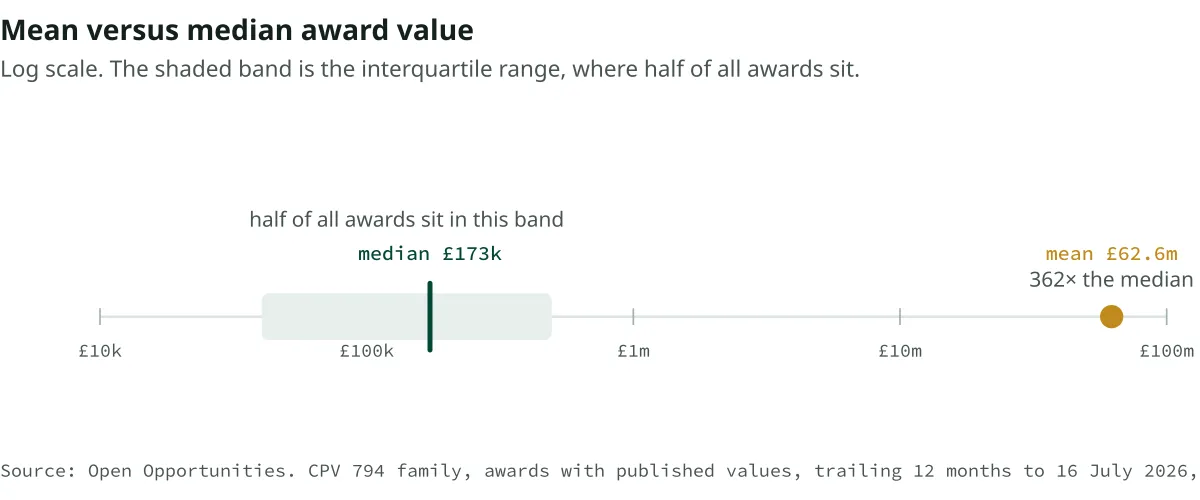
Strip out the thirty billion-euro records and the market looks like this: roughly £39 billion of awarded value in the trailing twelve months, across nearly 14,000 awards. The median award is £173,000, and the middle half of the market sits between £40,000 and £495,000. That is what public sector consulting demand actually looks like: thousands of six-figure engagements, not a handful of eleven-figure ones.
You can see the distortion in a single statistic. The mean award in the headline data is about £62.6 million. The median is £173,000. When the mean is 362 times the median, the mean is not describing the market. It is describing the ceilings.

What to do about it
None of this is a complaint about the source data. Publishers are following their own rules, and each convention makes sense locally. The problem only appears when you aggregate across 48 countries and treat every value field as if it means the same thing.
So three working rules. First, lead with counts and medians when you want to describe demand, and treat value totals as ceiling-inclusive until proven otherwise. Second, before quoting any market total, pull the largest records and label them: framework ceiling, ceiling multiplication, call-off repeat, republication, duplicate, or genuine mega-award. In this market the labelling took an afternoon and changed the answer by a factor of 22. Third, be suspicious of any market report that quotes a procurement total without telling you how it treated frameworks. If the methodology section doesn't mention ceilings, the headline number almost certainly includes them.
Volume without honesty is just a bigger wrong number.
Methodology
Scope: CPV group 794 (business and management consultancy and related services), including awards where a 794 code appears among multiple codes on the record. Window: trailing twelve months to 16 July 2026 unless stated. Awards with published values only; roughly 90 per cent of notices publish no value, so all figures understate total activity. Values converted to GBP at the time of aggregation.
The framework check examined every award of €1 billion or more (30 records in the window) plus the wider £1 billion-plus population, which was manually inspected and deduplicated. Data: Open Opportunities, aggregating 900+ official procurement sources across 180+ countries.