Is our search better than others?
We built a search algorithm to find the tenders that rival products miss.
We tested 100 searches on nine portals. Here's what we found.
Jump to a question: Will I see tenders I'm missing? How much rubbish will I wade through? Does it work for my trade? Can I check this? What will I still miss?
Will I see tenders I'm missing today?
Yes. Every time you search, you'll see tenders the portal's own search box never showed you. Not one or two over a year. Several, every search, on every portal we tested.
How we proved it
Same words, both search boxes
- The same searches, the same words, the same day: in the portal's search box and in ours.
- Then we counted the tenders each one showed that the other didn't.
- 100 searches on each of nine portals. We kept the first page of 20 and the first 100 results.
Ours, not theirs
Measured 16 September 2026. A first page is the first 20 results.
Theirs, not ours
Both lists were graded the same way. An independent reviewer, which we call the judge, read every open tender for every search and decided whether it matched.
How much rubbish will I have to wade through?
Some. Nobody's first page is all gold, because on any given day there just aren't many open tenders for your trade. The difference is where the rubbish sits. Ours goes to the bottom. The tenders worth opening are at the top, and they stay there.
How we proved it
Every result graded
- We graded every one of the first hundred results on both sides.
- Then we looked at where the good ones landed in each list.
- The pattern held on all nine portals.
Top of our list
300 relevant tenders among the 1,000 results at ranks 1 to 10, over 100 searches.
Page five of our list
108 relevant tenders among the 5,000 results at ranks 51 to 100.
Does it work for my trade and my country?
Try it. Describe what you do in your own words and see what comes back. That's the only test that matters.
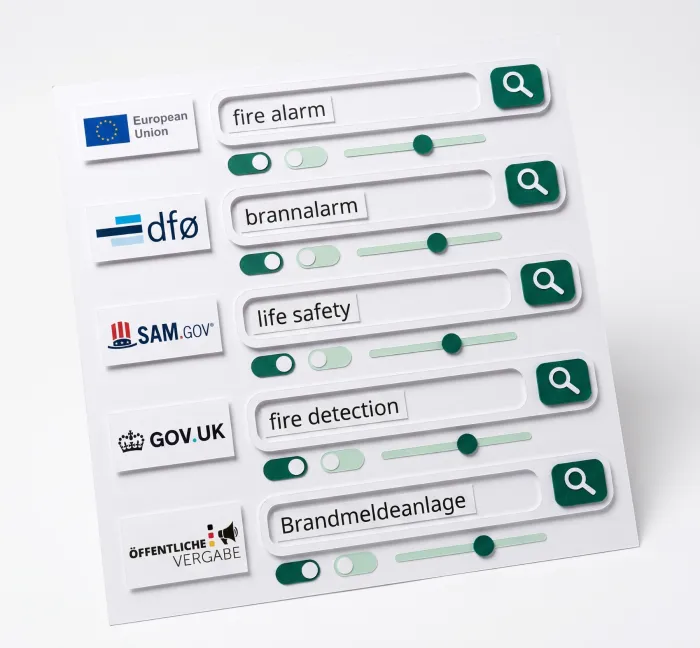
Try for yourself
Compare our search with any other tender portal
- 1. Just sign up to our free trial
- 2. Run your search in Open Opportunities
- 3. Do the same in another search engine
- 4. Compare the results
Can I check this?
Yes, all of it. Nothing here is our word for it. Real people checked the judge's work on every portal, and every search's results are yours to download, portal by portal, so you can check them and make up your own mind.
How we proved it
A person checked the reviewers decisions
- A native speaker re-graded 300 of the judge's decisions on each portal, without seeing what the judge had said.
- Every result list and every grade is on file. Ask and we'll send them.
The judge's marks
Lowest on Find a Tender, highest on BOAMP. Each portal's mark is on its card below.
Check it yourself
Each portal's card below has its own file. The full data pack is on the methodology page.
Portal by portal, first 100 results
United Kingdom · measured 16 September 2026
Find a Tender
UK- We showed
- 672
- of 709 relevant open tenders
- Portal showed
- 251
- of the same 709
- Judge agreed with
- 78 in 100
- checked by a native speaker
- On the first page
- 401 v 178
- of 442 relevant, first 20 results
Download the data
Results by search (CSV): the 100 searches on this portal, the relevant open tenders that existed for each, and what each search showed in its first 20 and first 100 results.
Summary of all nine portals (CSV). The full data pack and the method are on the methodology page.
Global · measured 15 September 2026
World Bank
Global- We showed
- 359
- of 372 relevant open tenders
- Portal showed
- 136
- of the same 372
- Judge agreed with
- 89 in 100
- checked by a native speaker
- On the first page
- 193 v 59
- of 210 relevant, first 20 results
Download the data
Results by search (CSV): the 100 searches on this portal, the relevant open tenders that existed for each, and what each search showed in its first 20 and first 100 results.
Summary of all nine portals (CSV). The full data pack and the method are on the methodology page.
Netherlands · measured 17 September 2026
TenderNed
NL- We showed
- 325
- of 340 relevant open tenders
- Portal showed
- 141
- of the same 340
- Judge agreed with
- 87 in 100
- checked by a native speaker
- On the first page
- 217 v 103
- of 246 relevant, first 20 results
Download the data
Results by search (CSV): the 100 searches on this portal, the relevant open tenders that existed for each, and what each search showed in its first 20 and first 100 results.
Summary of all nine portals (CSV). The full data pack and the method are on the methodology page.
Norway · measured 16 September 2026
Doffin
NO- We showed
- 388
- of 417 relevant open tenders
- Portal showed
- 202
- of the same 417
- Judge agreed with
- 90 in 100
- checked by a native speaker
- On the first page
- 201 v 87
- of 236 relevant, first 20 results
Download the data
Results by search (CSV): the 100 searches on this portal, the relevant open tenders that existed for each, and what each search showed in its first 20 and first 100 results.
Summary of all nine portals (CSV). The full data pack and the method are on the methodology page.
United States · measured 16 September 2026
SAM.gov
US- We showed
- 406
- of 432 relevant open tenders
- Portal showed
- 93
- of the same 432
- Judge agreed with
- 82 in 100
- checked by a native speaker
- On the first page
- 244 v 62
- of 269 relevant, first 20 results
Download the data
Results by search (CSV): the 100 searches on this portal, the relevant open tenders that existed for each, and what each search showed in its first 20 and first 100 results.
Summary of all nine portals (CSV). The full data pack and the method are on the methodology page.
Colombia · measured 16 September 2026
SECOP II
CO- We showed
- 563
- of 588 relevant open tenders
- Portal showed
- 96
- of the same 588
- Judge agreed with
- 88 in 100
- checked by a native speaker
- On the first page
- 316 v 51
- of 333 relevant, first 20 results
Download the data
Open-data search stands in for the site search, which is behind a reCAPTCHA.
Results by search (CSV): the 100 searches on this portal, the relevant open tenders that existed for each, and what each search showed in its first 20 and first 100 results.
Summary of all nine portals (CSV). The full data pack and the method are on the methodology page.
France · measured 16 September 2026
BOAMP
FR- We showed
- 1,372
- of 1,404 relevant open tenders
- Portal showed
- 165
- of the same 1,404
- Judge agreed with
- 94 in 100
- checked by a native speaker
- On the first page
- 579 v 132
- of 637 relevant, first 20 results
Download the data
Results by search (CSV): the 100 searches on this portal, the relevant open tenders that existed for each, and what each search showed in its first 20 and first 100 results.
Summary of all nine portals (CSV). The full data pack and the method are on the methodology page.
Germany · measured 16 September 2026
bund.de
DE- We showed
- 1,572
- of 1,660 relevant open tenders
- Portal showed
- 207
- of the same 1,660
- Judge agreed with
- 85 in 100
- checked by a native speaker
- On the first page
- 601 v 120
- of 682 relevant, first 20 results
Download the data
Results by search (CSV): the 100 searches on this portal, the relevant open tenders that existed for each, and what each search showed in its first 20 and first 100 results.
Summary of all nine portals (CSV). The full data pack and the method are on the methodology page.
European Union · measured 17 September 2026
TED
EU- We showed
- 3,753
- of 4,354 relevant open tenders
- Portal showed
- 904
- of the same 4,354
- Judge agreed with
- 86 in 100
- checked by a native speaker
- On the first page
- 1.1k v 273
- of 1,338 relevant, first 20 results
Download the data
Results by search (CSV): the 100 searches on this portal, the relevant open tenders that existed for each, and what each search showed in its first 20 and first 100 results.
Summary of all nine portals (CSV). The full data pack and the method are on the methodology page.
What will I still miss?
Some. Three things to know before you rely on us, and we would rather say them here than have you find out later.
What you will still miss
Not everything
Over all 900 searches together that is 866 of 10,276 relevant tenders, 8 in 100, because the biggest portals carry the most.
Not all at the top
The best results are not always in the first 50 for every search. Page through to 100 results if you want the 94 in 100.
Not instant
We gather from the portals twice a day, so a brand-new tender can take up to 12 hours to appear.
How we proved it
Counted the misses
- Of the relevant tenders either search showed in its first 100, we counted the ones ours did not show, portal by portal.
- Averaged across the nine portals that is 6 in 100. Pooled over all 900 searches, 866 of 10,276, 8 in 100.
- Each portal's pair is on its card above.
Checked where our results sat
- We split each search's first 100 results into rank bands and counted the relevant tenders in each.
- Across the nine portals, between 13 and 38 in 100 of the relevant tenders we found sat beyond rank 50 (pooled, 2,837 of 9,410); the shapes under question 2 show where.
How often we gather
- This one is not from the test. It is how our gathering runs: our index is rebuilt twice a day from tenders updated since the last run.
- So the longest wait for a new tender is 12 hours.
Relevant tenders on the first page of 20, per search, ours against the portal's. Find a Tender 5 v 2; World Bank 5 v 1; TenderNed 4 v 2; Doffin 4 v 2; SAM.gov 4 v 1; SECOP II 5 v 1; BOAMP 7 v 2; bund.de 8 v 2; TED 12 v 3.
In the first 100 results, of the relevant tenders either search found, the share each showed. Ours 86 to 98 in 100; the portals' own search 12 to 48.
Missed in the first 100, of the relevant tenders either search found, ours against the portal's. Find a Tender 37 v 458; World Bank 13 v 236; TenderNed 15 v 199; Doffin 29 v 215; SAM.gov 26 v 339; SECOP II 25 v 492; BOAMP 32 v 1,239; bund.de 88 v 1,453; TED 601 v 3,450.
Relevant results per ten, on our side, by position (ranks 1 to 10 / 11 to 20 / 21 to 50 / 51 to 100). Find a Tender 3.0 / 1.0 / 0.5 / 0.2; World Bank 1.4 / 0.5 / 0.3 / 0.2; TenderNed 1.6 / 0.6 / 0.2 / 0.1; Doffin 1.5 / 0.5 / 0.4 / 0.2; SAM.gov 1.8 / 0.7 / 0.3 / 0.1; SECOP II 2.2 / 0.9 / 0.5 / 0.2; BOAMP 3.7 / 2.1 / 1.3 / 0.8; bund.de 3.8 / 2.2 / 1.5 / 1.0; TED 6.2 / 4.9 / 4.0 / 2.9.
The judge's marks. Agreed with by a native speaker, of 150 tenders the judge called relevant: BOAMP 94 in 100; Doffin 90; World Bank 89; SECOP II 88; TenderNed 87; TED 86; bund.de 85; SAM.gov 82; Find a Tender 78. Of what the person would have called relevant, the judge found 67 to 93 in 100.
How we measured it. 100 searches, each a two-word term a supplier would type. The same words in the portal's own search box and in ours, on the same day. Every open tender on the portal listed and matched to our database, so both searches were judged on the same tenders. Both searches' first 100 results kept. A judge read every open tender for every search and graded it; native speakers checked 300 of its decisions per portal. Nine portals: Find a Tender, World Bank, TenderNed, Doffin, SAM.gov, SECOP II, BOAMP, bund.de, TED. Read the full method and download the data.
Now put your own searches to the test
The side-by-side challenge
Bring us the searches you run today
Whatever tool you use. Send us the searches and the results your current tool gives you, and we'll put them next to ours on the same queries, the same day, then show you notice by notice what each search returned.
20 minutes on a call · results back in two working days · you keep the list either way
- 1Book 20 minutes and bring your saved searches: a screenshot of the keywords is enough.
- 2On the call, export the results your current search engine gives you for those queries.
- 3We compare both lists and send back what you missed, plus what we missed.
Try Activity Search
See the difference now